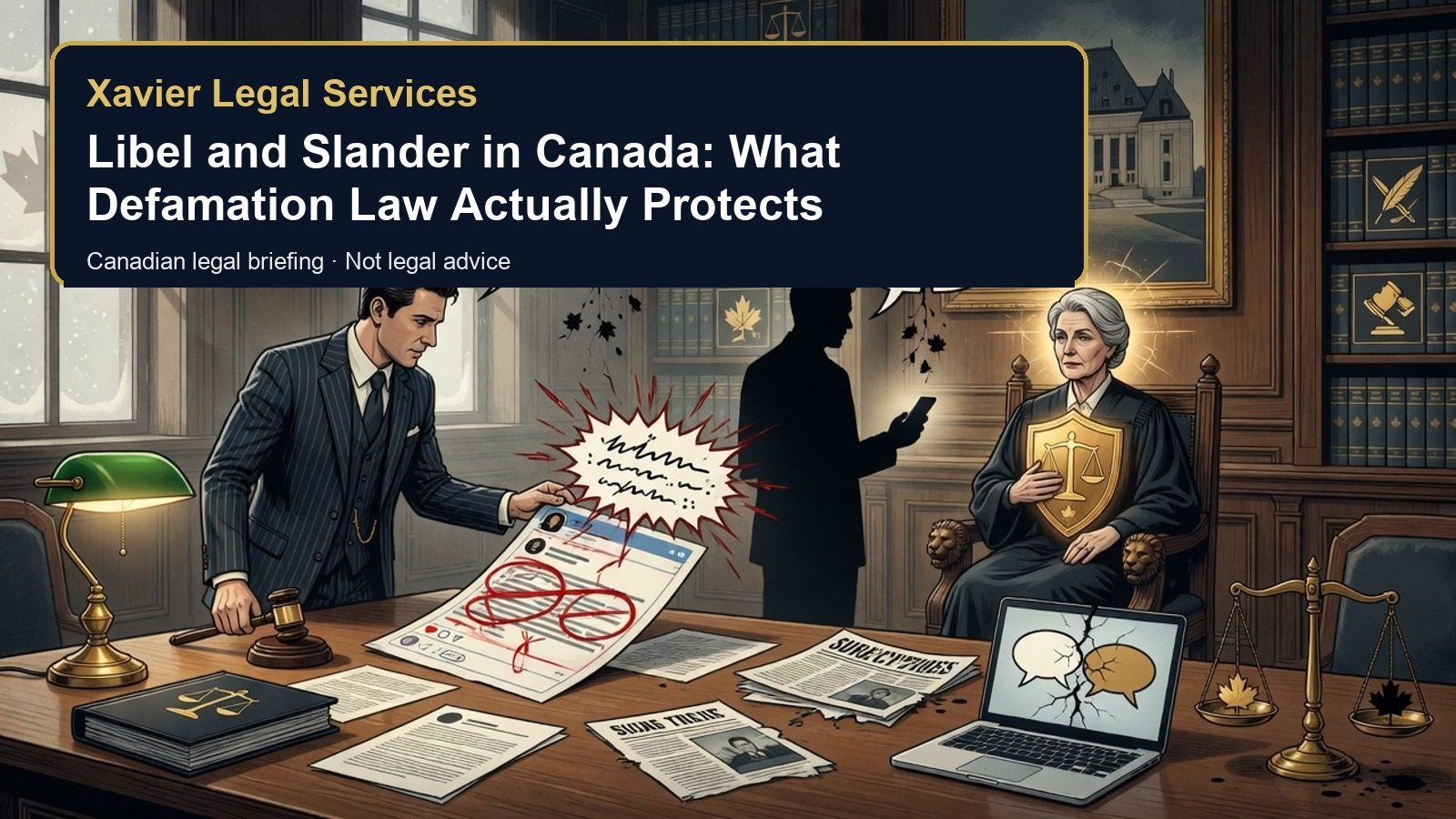
Canadian defamation law sits at the intersection of reputation, free expression, public-interest debate, and evidence. The labels “libel” and “slander” still matter in ordinary speech: libel usually refers to written or otherwise recorded statements; slander usually refers to spoken words. In practice, modern disputes often involve social media posts, emails, websites, videos, reviews, or forwarded messages — so the practical question is less the old label and more whether the statement was published, identified the plaintiff, and would tend to lower reputation in the eyes of a reasonable person.
The basic structure of a Canadian defamation claim
At a high level, a plaintiff usually must show that the words were communicated to at least one person other than the plaintiff, that the words referred to the plaintiff, and that the words would tend to harm reputation. Once that threshold is met, the fight often shifts to defences: truth/justification, fair comment, privilege, responsible communication on matters of public interest, consent, and statutory or procedural protections.
Public-interest reporting and “responsible communication”
In Grant v. Torstar Corp., the Supreme Court of Canada recognized the defence of responsible communication on matters of public interest. The Court held that defamation law must protect reputation while also giving breathing room to public-interest journalism and expression, provided the publisher acted responsibly in trying to verify the information.
That does not mean “anything goes” online. The defence is contextual. Courts may look at seriousness, public importance, urgency, source reliability, whether the plaintiff’s side was sought and fairly reported, and whether the article’s tone and wording were responsible.
Opinion, fair comment, and heated debate
Canadian law also protects some opinions through the fair comment defence. In WIC Radio Ltd. v. Simpson, the Supreme Court framed fair comment as an important protection for public debate, while still requiring that the comment be based on facts and recognizable as comment rather than a false assertion of fact.
That distinction matters for businesses, activists, directors, landlords, professionals, and public figures. “I think this policy is reckless” is different from asserting a specific criminal act, fraud, abuse, or professional misconduct as fact without a source trail.
Anti-SLAPP motions and public participation
Several Canadian provinces have anti-SLAPP legislation designed to screen lawsuits that unduly chill expression on matters of public interest. In Bent v. Platnick and Hansman v. Neufeld, the Supreme Court considered how courts should balance reputation, public-interest expression, harm, and the merits at an early stage.
The practical lesson is two-sided: people harmed by false statements still have recourse, but plaintiffs should expect courts to ask whether the lawsuit is genuinely about vindicating reputation or whether it risks suppressing public participation.
What to do before sending a defamation demand
- Preserve the exact publication: screenshots, URLs, timestamps, authorship, comments, reposts, and analytics if available.
- Separate statements of fact from opinion, insult, parody, rhetorical exaggeration, or fair comment.
- Assess defences before threatening litigation: truth, fair comment, privilege, public interest, and responsible communication.
- Consider proportional remedies: correction, takedown, apology, reply, de-indexing, or negotiated undertaking.
- Move quickly if the post is spreading, but avoid overbroad threats that can backfire publicly.
Bottom line: Canadian defamation law protects reputation, but it also protects responsible public-interest expression. The strongest approach is precise, evidence-based, and proportionate.
Sources and further reading
- Supreme Court of Canada: Grant v. Torstar Corp., 2009 SCC 61
- Supreme Court of Canada: WIC Radio Ltd. v. Simpson, 2008 SCC 40
- CanLII: Bent v. Platnick, 2020 SCC 23
- CanLII: Hansman v. Neufeld, 2023 SCC 14